
NTAG213 vs NTAG215 vs NTAG216: Which Tag to Buy?
Compare NTAG213, NTAG215 and NTAG216 by memory, link length and best use, check what your content needs before you buy, and avoid tags iPhone cannot read.
For a single web link, buy NTAG213: its 144 bytes hold a link of about 130 characters, which is enough for most links. Choose NTAG215 (504 bytes) for long links or several records on one tag, and NTAG216 (888 bytes) for contact cards. Apart from memory, the three chips work the same way, and all of them work with every iPhone from iPhone 7 onward.
This guide compares them side by side, shows how to measure your content before you order, and lists what to check in a product listing.
NTAG213, NTAG215 and NTAG216 at a glance
All three chips are made by NXP and belong to the same family, NTAG21x. They are NFC Forum Type 2 tags (ISO/IEC 14443-A) and work at 13.56 MHz, the frequency NFC uses. The real difference is how much they can store.
| Chip | NTAG213 | NTAG215 | NTAG216 |
|---|---|---|---|
| User memory | 144 bytes | 504 bytes | 888 bytes |
| Longest web link | about 130 characters | about 490 characters | about 860 characters |
| Best for | One link, a phone number, a Shortcuts trigger | Long links, Wi-Fi plus a link, several records | Contact cards, a link plus a contact card, longer text |
Everything else is the same on all three:
- A 7-byte serial number (UID), set at the factory. It cannot be changed.
- About 100,000 write cycles and about 10 years of data retention.
- An optional 32-bit password that stops others from rewriting the tag.
- Lock bits that can make the tag read-only forever.
So you are choosing memory, nothing else.
What fits in 144, 504 and 888 bytes
For a web link, one byte is roughly one character. Two details change the count:
- Common link starts are stored as a 1-byte code. "https://www." takes 1 byte, not 12.
- Every record needs a few bytes to describe itself. That is why 144 bytes hold a link of about 130 characters, not 144.
Take https://www.example.com/menu as an example. Only "example.com/menu" (16 characters) is stored in full, so the whole content uses fewer than 30 bytes. NTAG213 has room for a link several times longer.
Very long links usually come from tracking parameters, the part after the question mark (?). Links copied from apps, online forms and marketing tools can pass 130 characters because of them. Remove the parts the page does not need, choose NTAG215, or point the tag to a short page on your own domain. Avoid public link shorteners: they hide where the link goes, so security tools treat them as a warning sign. The Link Shield check in TagForge flags them too.
Contact cards grow quickly, because each field (name, company, job title, phone, email, website, address, note) adds a label as well as a value. A short contact card can fit on NTAG215. NTAG216 has room for every field and a link on the same tag, which is why it is the safe choice for contact cards.
Several records on one tag add up in the same way. A Wi-Fi network plus a link can pass 144 bytes, depending on the length of the network name, the password and the link.
If the tag only triggers a personal automation in the Shortcuts app, memory does not matter at all. The automation recognises the tag itself, so even a blank NTAG213 usually works.
Measure your content before you buy
The surest way to pick a chip is to compose the content first. In TagForge, open the Write tab and add your records: a link, a Wi-Fi network, a contact card, or several of them together. The size meter shows how many bytes the content needs and which chip it fits:
- Fits NTAG213+: any of the three chips will do.
- Needs NTAG215+: buy NTAG215 or NTAG216.
- Needs NTAG216: only the largest chip has room.
- Larger than NTAG216: shorten the content, or move the details to a web page and store only its link.
You can do this before you own a single tag, because composing does not need one. If you expect the content to grow, for example a contact card that may get a second phone number, leave some free space.
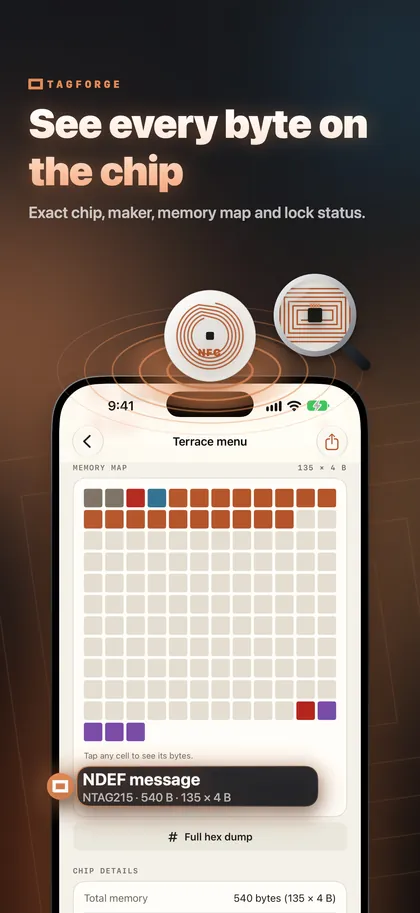
When the tags arrive, scan one with TagForge. It shows the chip model and maker (for example "NTAG215 · NXP"), used and total memory, and whether the tag is locked or password-protected. That is a quick way to confirm that you received what you ordered.
Stickers, keyfobs, cards or on-metal tags
The chip decides the memory. The form factor decides where the tag can go. Each chip is sold in several forms:
- Stickers are thin labels with an adhesive back, round or square. Use them on posters, table stands, packaging and walls. For outdoor use, choose stickers sold as waterproof.
- Keyfobs are tags sealed in hard plastic or epoxy, with a hole for a key ring. They suit customers, staff and members who carry them every day.
- Cards are credit-card size and often printable. They suit business cards, membership cards and guest cards. If a card will hold a contact card, choose NTAG216.
- On-metal tags are built for metal surfaces. Metal detunes a normal tag, so a regular sticker on a fridge, a machine or a metal door frame may not read at all.
Think about placement too. The iPhone's NFC antenna is at the top edge, on the back near the cameras, and the range is only about 1–4 cm (under 1.5 in). Put tags where people can easily bring the top of the phone close, and mark the spot.
What else to check in a product listing
- Standard and frequency. Look for "NFC Forum Type 2", "ISO/IEC 14443-A" and "13.56 MHz", and for the exact chip name: NTAG213, NTAG215 or NTAG216.
- No 125 kHz tags. Keyfobs and cards sold as 125 kHz RFID (EM4100, HID Prox and similar) are not NFC. An iPhone cannot see them at all.
- No MIFARE Classic for iPhone projects. It is common in older access cards, hotel keys and gym fobs, but an iPhone cannot read it.
- Blank and unlocked. If you will write the tags yourself, make sure they are not locked. A permanently locked tag can never be rewritten.
- Other chips. An iPhone also reads MIFARE Ultralight and Ultralight EV1, MIFARE DESFire, ICODE SLIX and FeliCa. They have their uses, but for links, Wi-Fi and contact cards, NTAG21x is the simplest choice.
Which one should you buy?
- One link, a review page, a menu or a Shortcuts trigger: NTAG213.
- Long links, Wi-Fi plus a link, or two or three records: NTAG215.
- A contact card, or a link plus a contact card: NTAG216. Our guide to NFC business cards explains when a link alone is the better choice.
- Not sure: compose the content first and let the size meter decide.
Whichever chip you choose, protect tags in public places. A password stops casual overwriting, and a permanent lock makes the tag read-only forever. Our guide on how to lock or password-protect an NFC tag explains when to use each. When your tags arrive, follow the steps in how to write NFC tags with iPhone.
FAQ
Is NTAG215 better than NTAG213?
Only if you need the space. NTAG215 has 504 bytes of user memory instead of 144. Otherwise the two chips are the same: a fixed 7-byte serial number, about 100,000 write cycles, an optional password and permanent lock bits. For one link, NTAG213 is enough.
What size NFC tag do I need for a URL?
NTAG213 holds a link of about 130 characters, NTAG215 about 490 and NTAG216 about 860. Because "https://www." is stored as 1 byte, most website links fit on NTAG213.
Do NTAG215 and NTAG216 tags work with iPhone?
Yes. Every iPhone from iPhone 7 onward can read them with an app, and iPhone XS / XR and later read web links from them without an app. Writing needs an app and iOS 13 or later.
How many times can you rewrite an NTAG tag?
About 100,000 times, and the data stays readable for about 10 years. The exception is a permanently locked tag: it can never be rewritten.